Three shocks. One year.
Two climate shocks, one geopolitical, and what they mean for agricultural output and prices.
El Niño in the PacificDrought and heat in Western EuropeDisruption in the Strait of Hormuz
Three unrelated shocks are reaching the harvests in the same season.
Prepared as part of the Observatoire Swanstant × Paris Good Fashion.
2 / 7
Two transmissions sit between a climate signal and the price buyers pay.
A climate signal matters economically if it survives each link in the chain.
3 / 7
El Niño shifts the odds but does not fix the season.
El Niño is a useful predictor only where its effect is consistent enough to add information beyond the local weather affecting the crop.
4 / 7
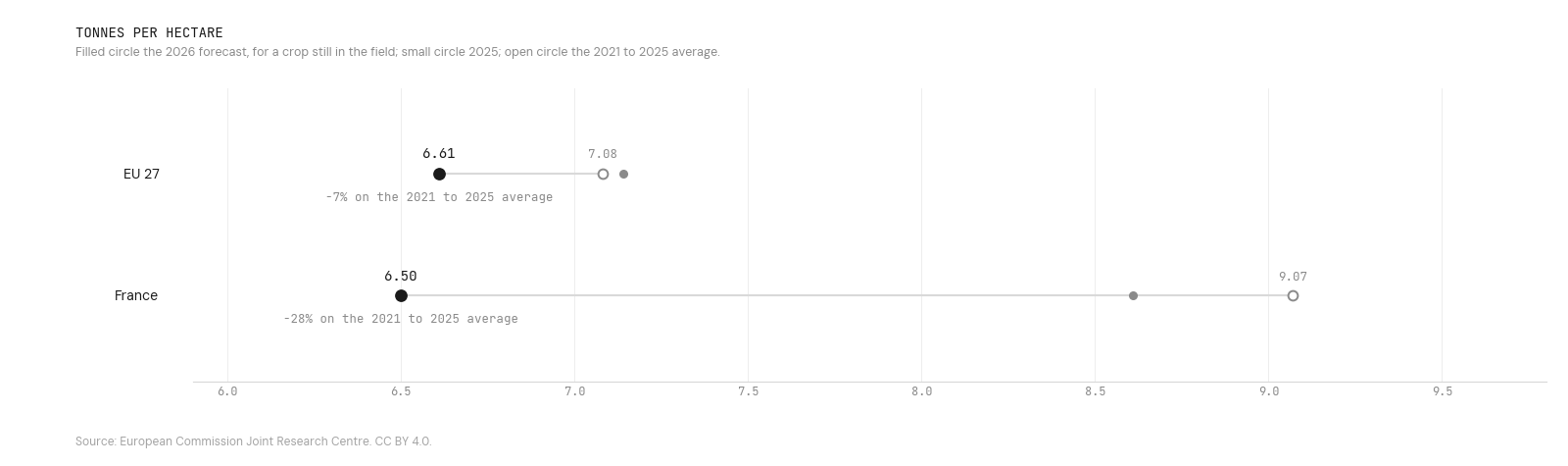
In Europe, this season has delivered some of the weakest harvests in decades.
France is heading for its smallest maize and sugar beet crops since 1980.
5 / 7
Critical buffers stand between the harvest and the price.
A production loss somewhere matters to price only if buyers cannot replace it somewhere else.
6 / 7
Water buffers seasonal weather. But in some regions, it has been depleted faster than it could rebuild.
A region can look resilient to drought today because it is drawing down the resource that protects from it.
7 / 7
A harvest failure can drive local food prices up without lifting the global benchmark.
For food security, the price local buyers pay matters more than the world benchmark.
Three shocks. One year.
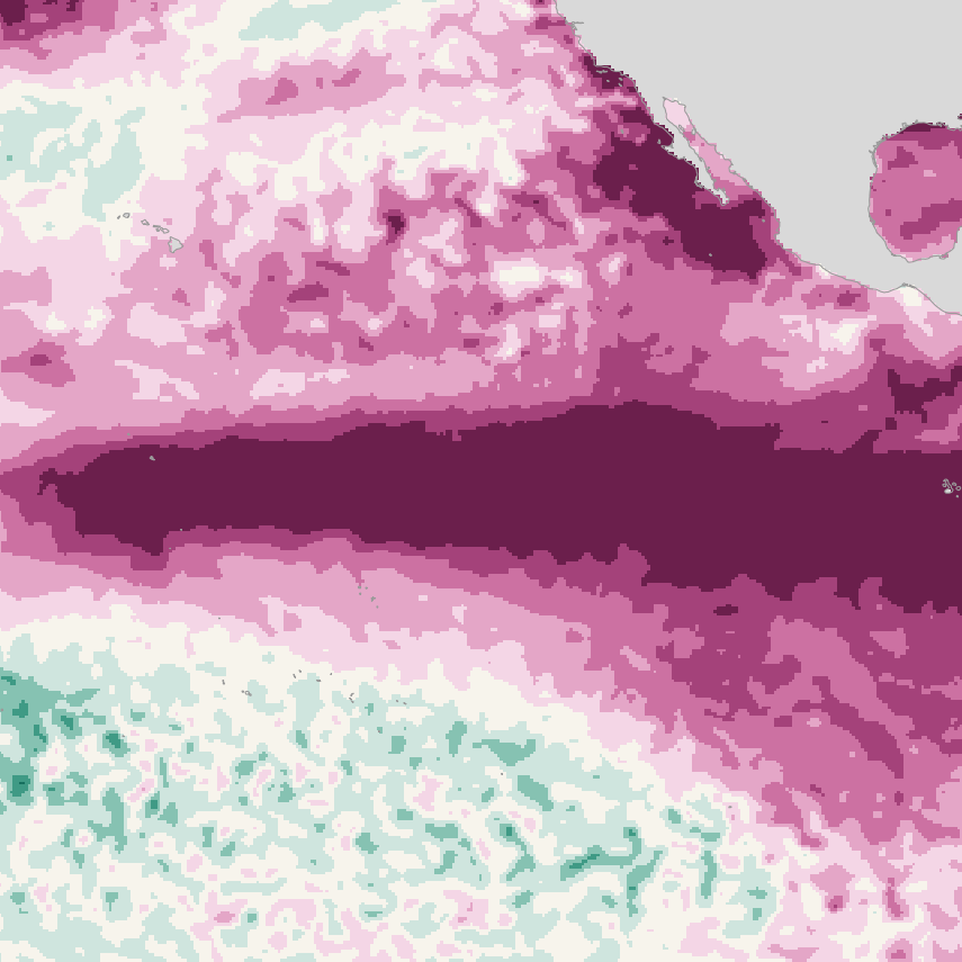
El Niño is strengthening in the Pacific. Drought and heat have already affected growing conditions across parts of Europe, and heat those in the US Plains. At the same time, disruption around the Strait of Hormuz is exposing fuel and fertiliser costs to a separate geopolitical shock.
Their causes are independent, but their impact is not, exposing producers to weaker output and a higher cost base at the same time.
That is why analysing each shock in isolation can understate the combined exposure. The rest of the page follows the channels that determine whether these signals reach the crop, the supply available to buyers and ultimately the price they pay.
Methodology and references
WMO, El Niño/La Niña Update, 3 September 2026. NOAA Climate Prediction Center, ENSO Diagnostic Discussion, 10 September 2026, and Relative Oceanic Niño Index (ERSSTv6). NOAA OISST v2.1 via NOAA PSL, anomaly computed against the product's own 1991 to 2020 daily mean. NASA POWER (MERRA-2 derived), April to August, ranked over the 36 growing seasons of 1991 to 2026. IMF PortWatch, daily chokepoint transit calls. US Energy Information Administration, weekly retail diesel. World Bank, Commodity Price Data, urea.
Two transmissions sit between a climate signal and the price buyers pay.
The first transmission runs from the Pacific signal to local weather and then to the crop. The second runs from the harvest to the supply buyers can actually reach and then to price.
Each link has its own buffers. Irrigation can weaken the connection between rainfall and yield. Stocks, alternative origins, logistics and policy can weaken or amplify the connection between a harvest loss and price.
Methodology and references
Swanstant analytical framework.
El Niño shifts the odds but does not fix the season.
In our validated models, El Niño is rarely used on its own. Where it is retained, it usually works alongside local variables such as rainfall, heat or atmospheric moisture demand. In US maize, once those local conditions are known, the model finds no additional predictive value in the Pacific signal.
The historical weather record illustrates this. For El Niño to be useful before the local season unfolds, its impact has to have been reasonably consistent across previous events. In central India, El Niño years have more often coincided with a weaker monsoon. Across parts of the southern African belt, the same Pacific signal has produced much more varied local seasons.
El Niño is therefore a prior, not a harvest forecast. Its value falls as local weather and crop conditions become observable.
Methodology and references
Swanstant crop-climate models, PCI v2; classification as at 20 August 2026. The US maize model was offered seven El Niño series and retained none once local heat, rainfall and moisture demand were available. In central India, the cotton model retained a single El Niño term in combination with rainfall.
Central India: in the cotton belt, the June to October rains came in below the 1991 to 2020 normal in ten of the eleven El Niños since 1981 whose peak Oceanic Niño Index reached 1.0 or more, and in eight of ten on the relative index. Seasonal rainfall is skewed, so somewhat more than half of all years fall below normal in any case.
Swanstant analysis of NASA POWER (MERRA-2 derived), over the growing seasons for each El Niño's developing year, against the 1991 to 2020 normal; direction checked against NOAA CPC's gauge-based analysis. POWER rainfall is a reanalysis product rather than a gauge record. Events: peak traditional Oceanic Niño Index (ERSSTv6) of 1.0 or more, and, for the relative index, RONI. Growing-season windows: USDA NASS AH-628, GEOGLAM CM4EW v1.3, INTA/MAGyP. WMO, El Niño/La Niña Update, 3 September 2026.
In Europe, this season has delivered some of the weakest harvests in decades.
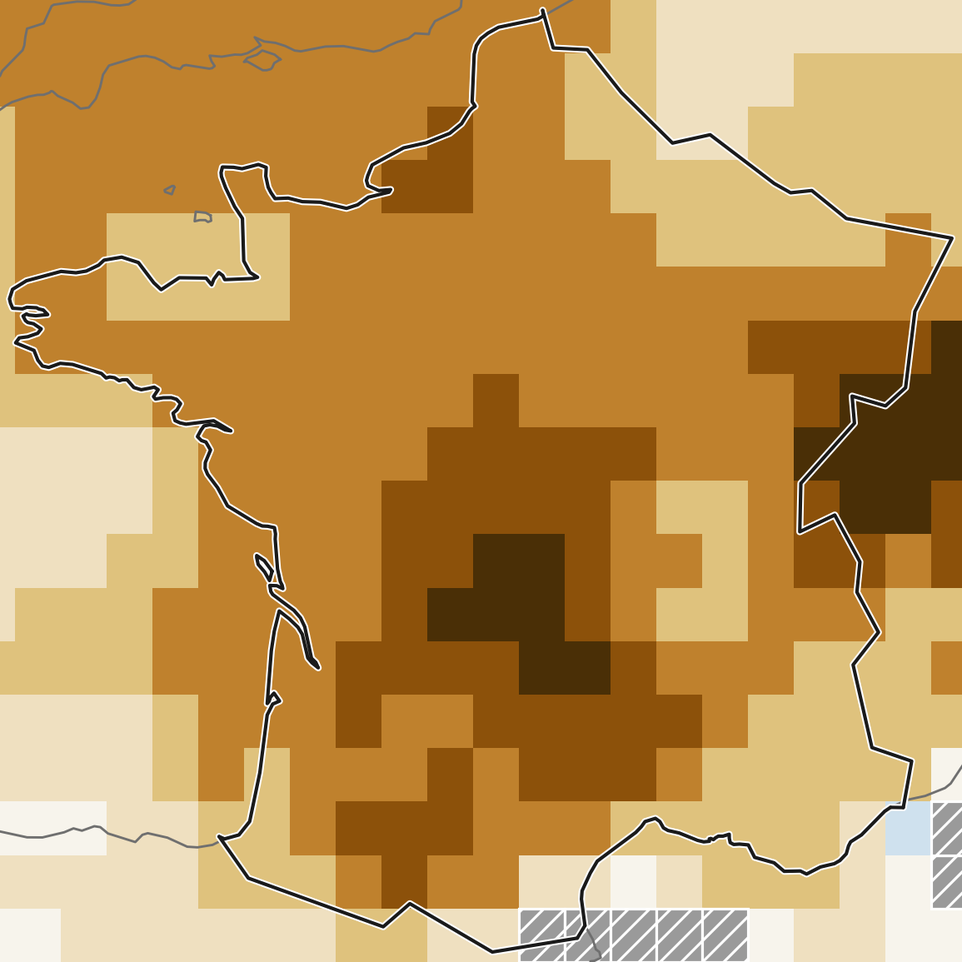
Several European producers are heading for some of their weakest harvests on record. In France, Agreste forecasts grain maize production at its lowest since 1980, and sugar beet down about 29% on 2025, the smallest crop since 1980. In the UK, the Energy and Climate Intelligence Unit estimated in August 2026 that the cereals-and-oilseeds harvest could total approximately 19.5 million tonnes, which under its central estimate would make it the worst in the series since detailed records began in 1984.
This shock carries into processing. The growers' union puts the sugar beet loss at about €1 billion, and sugar groups are shortening their campaigns to around 100 days, against 130 last year.
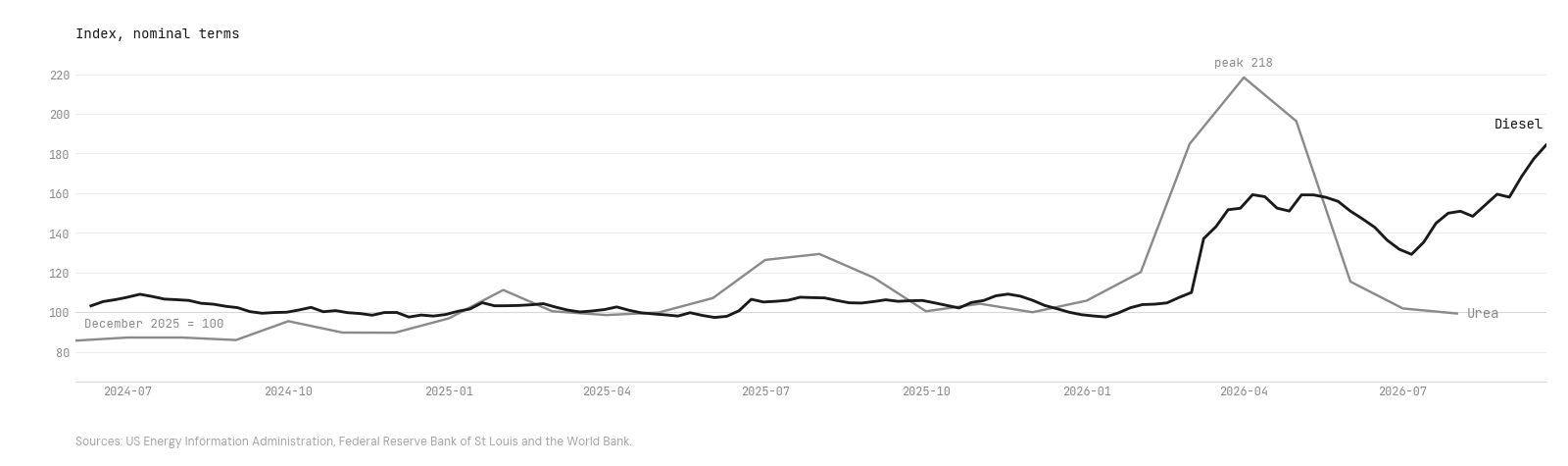
This reduced income potential is compounded by input costs. Urea has fallen back from its spring peak, but diesel remains at a record high in nominal terms.
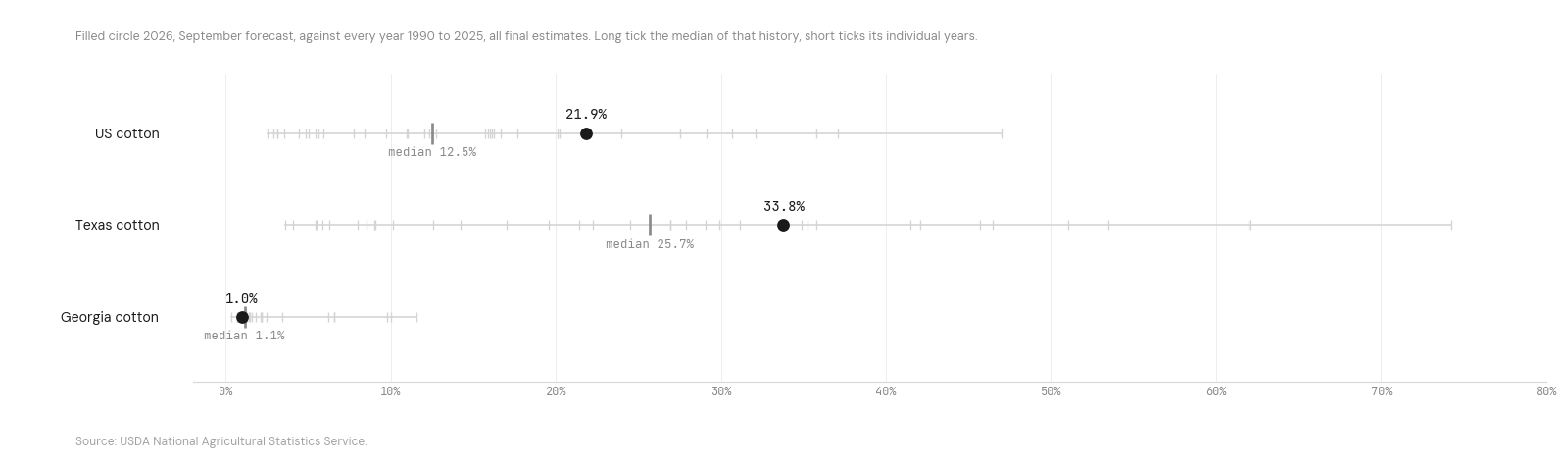
Cotton abandonment is forecast above its usual share in Texas and across the US. Weather drives much of it, but higher harvesting costs, diesel above all, raise the yield a field needs to be worth harvesting.
Methodology and references
JRC MARS, Crop monitoring in Europe, Vol. 34 No. 7, 24 August 2026. European Commission DG AGRI, EU cereals production, 25 August 2026. Agreste, Infos rapides Grandes cultures, estimates at 1 September 2026. Sugar beet: Agreste forecast of 68.2 t/ha on 372,702 ha, about 25.4 million tonnes, down 29% on 2025 and the lowest since at least 1980, as reported by Terre-net, 15 September 2026; CGB loss estimate, Réussir and Terre-net, 18 September 2026; campaign lengths, Réussir, 18 September 2026; the growers' union also expects thousands of hectares to go unharvested, and growers fear that fields with heavy weevil damage will be refused by the sugar groups (Réussir). Energy and Climate Intelligence Unit, August 2026. USDA NASS Crop Production, September 2026; abandonment computed by Swanstant from planted and harvested area. US Energy Information Administration, weekly retail diesel; World Bank, urea.
Agreste's own releases could not be retrieved, so both French claims rest on published reports that name Agreste as their source. The primary release was not accessed.
Pleinchamp, Raphaël Lecocq, Moisson 2026 : les cultures de printemps dévissent, maïs et betteraves au plus bas depuis 1980, 15 September 2026. pleinchamp.com, moisson-2026
Terre-net, Sophie Guyomard, Betteraves sucrières : Agreste publie ses premières prévisions de rendements 2026, 15 September 2026. terre-net.fr, article 903454
Réussir Grandes Cultures, Christian Gloria, Sécheresse 2026 : une crise majeure pour la betterave sucrière dont la production va chuter de 30 %, 18 September 2026. reussir.fr, secheresse-2026-betterave
Terre-net, Delphine Jeanne, Près d'1 milliard d'euros de pertes pour la filière betterave-sucre, 18 September 2026. terre-net.fr, article 903649
Réussir of 18 September prints the beet crop as 26.4 million tonnes. The 25.4 million tonnes above is Terre-net's of 15 September, and it is the figure that reconciles: 372,702 hectares at 68.2 tonnes a hectare is 25.42 million tonnes.
Critical buffers stand between the harvest and the price.
Reported stocks can buffer a seasonal shortfall, but only if buyers can reach them. Stocks held in countries that rarely export seldom reach the market, while alternative origins, grade and logistics condition whether one supply can replace another.
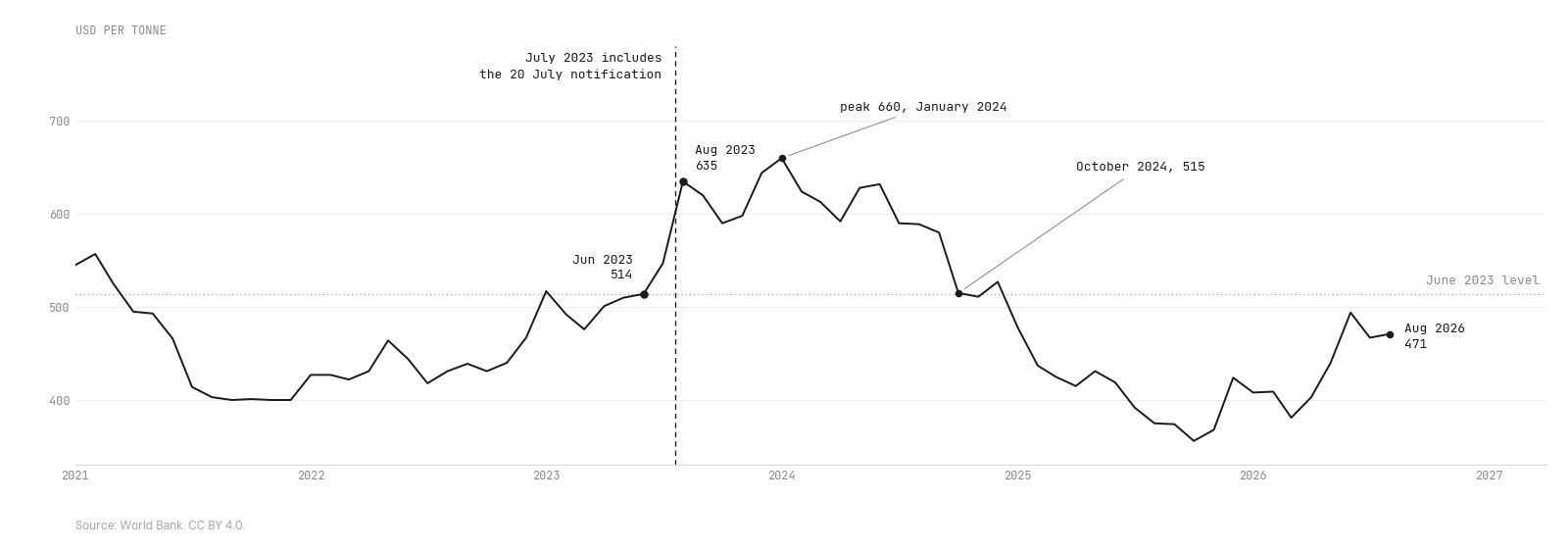
Policy can change that accessibility almost overnight. India's 2022/23 rice harvest was a record, yet in July 2023 the country banned exports of non-basmati white rice, removing supply from the international market. A peer-reviewed study finds the ban raised rice prices by up to 32% in key exporting markets such as Thailand.
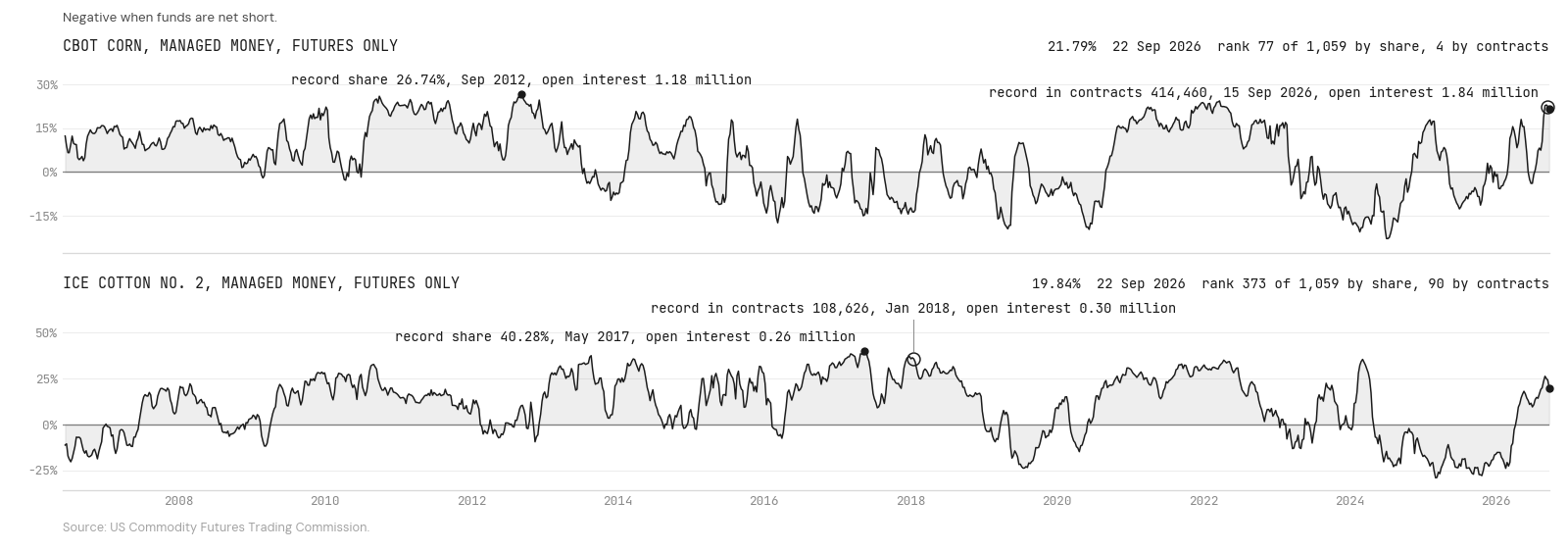
Markets can then amplify the physical signal. When positioning is crowded, new information can force many investors to adjust at the same time, moving prices before the underlying supply balance has materially changed.
Methodology and references
China holds a large share of world stocks of the four crops shown and rarely exports them. The adjusted stocks-to-use figure is illustrative and does not imply that all remaining inventories are freely tradable or commercially accessible.
On the World Bank's Thai 5% series, prices rose sharply between June 2023, the last full month before the notification, and August 2023, the first full month after it, and the rise had fully unwound by October 2024. Each monthly value averages weekly prices, so July spans the notification. The study also puts the annual consumer surplus loss at $315 million.
Positioning is the managed-money net position, long minus short, divided by open interest in the same report. Open interest changes slowly, so the share follows the contract count closely; the two differ where the market grew, which is why corn's record in contracts is recent while its record share is from 2012. Every figure printed is a level or a rank.
Sources: USDA WASDE, September 2026. India Ministry of Agriculture and Farmers Welfare, Third Advance Estimates, 25 May 2023. Directorate General of Foreign Trade, Notification 20/2023, 20 July 2023. World Bank, Commodity Price Data (Pink Sheet), Rice, Thai 5%, monthly, CC BY 4.0. Nes, K., Schaefer, K.A. and Yu, J. (2025). Economic impacts of the Indian ban on non-Basmati rice exports. Food Policy, 134, 102893. CFTC Commitments of Traders, disaggregated, futures only, to 22 September 2026.
Water buffers seasonal weather. But in some regions, it has been depleted faster than it could rebuild.
Irrigation is one reason a dry season does not automatically become a poor harvest. We see this buffer operating on two different time scales.
Seasonal: what matters is whether water is physically available and whether farmers are allowed to use it.
Cross-seasonal: repeated withdrawals can reduce the resource that makes that resilience possible.
That creates an asymmetry in climate risk. A successful harvest today does not necessarily mean exposure has fallen. It may actually mean the buffer has been used. The ability to irrigate this season might not be extrapolable to future ones. For example, Spain's reservoirs were refilled by a wet start to the year, but that does not carry into next year.
Access is governed by rules as well as hydrology. In a drought, drinking water is usually protected first and irrigation is restricted progressively, zone by zone. This means a region can have water in the system while being unable to use it for crops. In France, the sugar beet sector is now asking the state for an ambitious water-access policy.
Methodology and references
Surface reservoirs, total water storage and groundwater are different measures and none stands in for another.
On the southern High Plains, the water table has fallen in seventeen of the last eighteen winters. The record is not uniform: the most recent USGS interval, 2017 to 2019, showed a slight rise, and Kansas measured a small rise in 2025, driven by aquifers outside the Ogallala. On the Colorado, the reservoirs are an operating buffer rather than the underlying groundwater resource: a run of good snow years can refill them on a timescale that an aquifer cannot match.
In France, restrictions are issued by prefectoral order under the national drought framework, décret n° 2021-795 of 23 June 2021. The décret sets the four graduated levels, the zone d'alerte as the unit and the priority of first-necessity uses. The per-use ladder, including the irrigation restrictions, is set by the prefects' framework orders and described by the Ministère de la Transition écologique.
AEMET supports a wet start to the year for January and February 2026 only. March was normal, April very dry and May dry. AEMET marks its own monthly figures provisional, so no percentage is printed here.
Décret n° 2021-795 du 23 juin 2021 relatif à la gestion quantitative de la ressource en eau et à la gestion des situations de crise liées à la sécheresse. JORF n° 0145 du 24 juin 2021, NOR TREL2101597D. legifrance.gouv.fr/jorf/id/JORFTEXT000043694462
Code de l'environnement, articles R. 211-66 à R. 211-70, Zones d'alerte et restrictions provisoires d'usages, version in force since 25 June 2021, as modified by décret n° 2021-795. legifrance.gouv.fr/codes/id/LEGISCTA000043698540
Agencia Estatal de Meteorología, Resumen climatológico mensual, enero 2026, retrieved 28 September 2026. aemet.es, res_mens_clim_2026_01.pdf
Agencia Estatal de Meteorología, Resumen climatológico mensual, febrero 2026, retrieved 28 September 2026. aemet.es, res_mens_clim_2026_02.pdf
Sources: VigiEau, restrictions at the 25 August 2026 peak. MITECO, reservoir storage, 22 September 2026, provisional. USGS Scientific Investigations Report 2023-5143, data year 2019. Texas Water Development Board, Llano Estacado winter measurements, 2026. Kansas Geological Survey, provisional 2025 measurements. US Bureau of Reclamation, reservoir status. AEMET, monthly climate summaries for peninsular Spain, January and February 2026, provisional. Ministère de la Transition écologique, drought restriction levels. CGB water-access demand: Terre-net, 18 September 2026. BRGM groundwater levels through the Hub'Eau piezometry API, Licence Ouverte. Monthly means of the water table elevation at 1,865 monitoring wells, each ranked against the same calendar month at that well over 1996 to 2025. Class breaks are BRGM's own published IPS breaks; the index behind them is computed by Swanstant from raw levels.
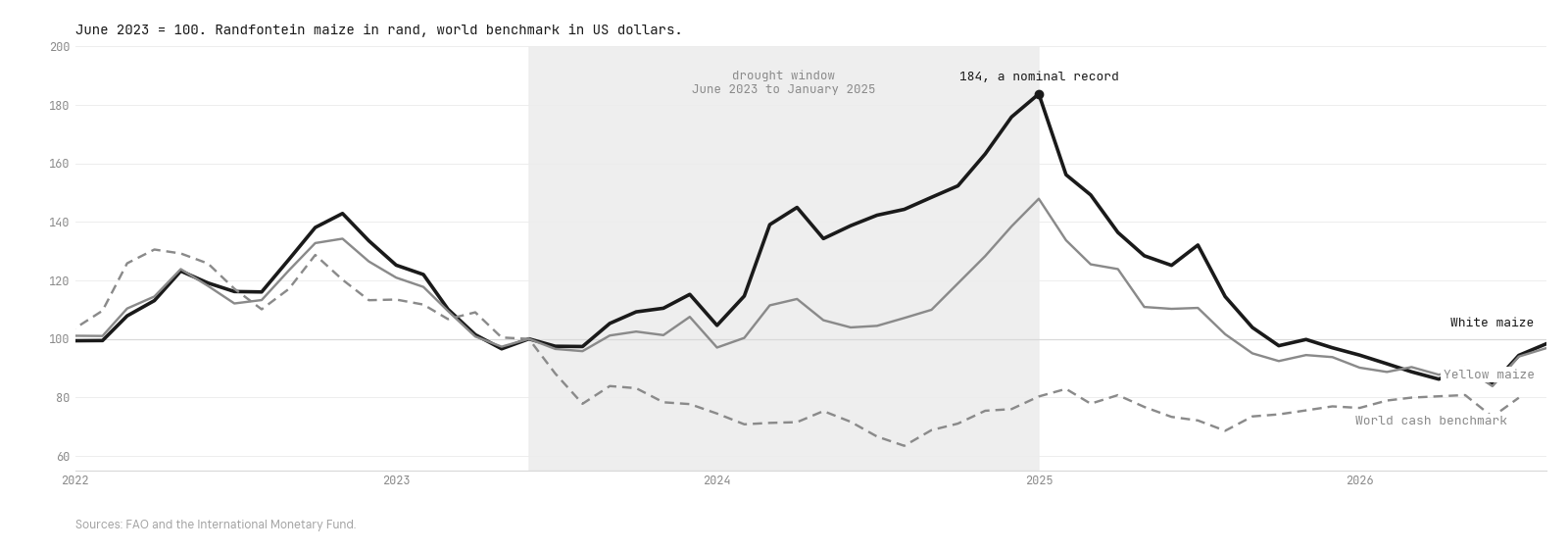
A harvest failure can drive local food prices up without lifting the global benchmark.
Southern Africa was hit by a severe food crisis in 2024. White maize, the staple consumed across much of the region, nearly doubled in price over the drought. At the same time, the world corn benchmark weakened.
There is no contradiction. The world benchmark is a price for yellow corn, a different grade on a different market, and it does not register a local shortage of white maize.
Methodology and references
In 2024, maize harvests failed in Zambia and Zimbabwe and fell sharply in Malawi. At Randfontein, white maize reached the highest nominal price in a series that begins in 2000; in real terms it was the sixth highest month, behind the 2016 drought. The rand moved 0.2% against the dollar across the window, which is what allows the local prices to sit beside a dollar benchmark.
The world corn benchmark fell over the drought window shown, although over calendar 2024 alone it rose slightly.
Sources: FAO GIEWS Food Price Monitoring and Analysis, South Africa, Randfontein wholesale white and yellow maize, rand per tonne (underlying source: SAFEX, JSE), monthly from January 2000. IMF, Primary Commodity Prices, Global price of Corn, US No. 2 yellow, FOB Gulf of Mexico, via FRED series PMAIZMTUSDM. FEWS NET, OCHA and ACAPS assessments, 2024. FAO production estimates for Malawi.
International Monetary Fund, Primary Commodity Prices, monthly data file, series PMAIZMT, whose commodity description reads "Maize (corn), U.S. No.2 Yellow, FOB Gulf of Mexico, U.S. price, US$ per metric ton". File last modified 9 September 2026, retrieved 28 September 2026. imf.org/en/Research/commodity-prices